Planting a Vineyard Part 20: Winter Absurdities
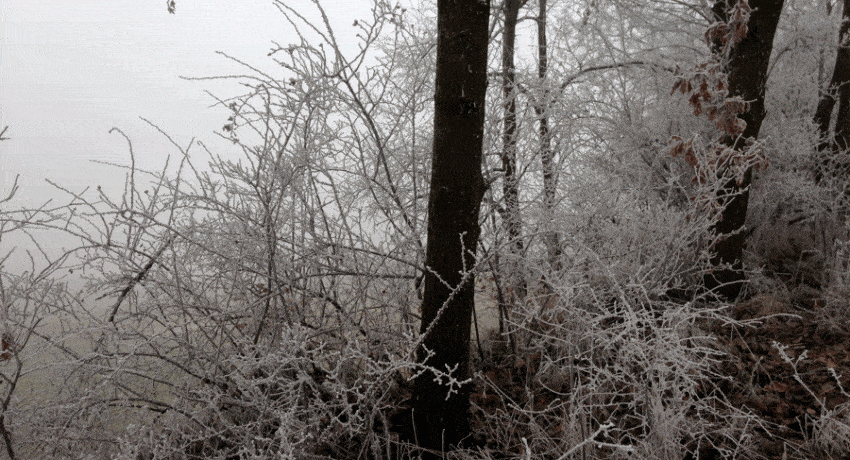
I’m speeding on my motorcycle, suddenly the engine stops without warning, I instinctively swerve to the side of the road, and then the motorcycle comes to a complete standstill, silence.
Such a brutal leap from one reality to another, without a transition period, without a moment’s respite. This was the case in Pondicherry, the Indian capital of Tamil Nadu. I’m experiencing the same feeling now, in Rybna, this time not because of a lack of petrol, but because of the arrival of winter. Without a word of warning, the machines fall silent, the birds fall silent, the earth falls silent. Only the wind, piercing and cold, prevents us from standing still, forces us to move.
However, this peace is illusory. Although I haven’t been physically on the plot for a month, I don’t feel a moment of stagnation; the fight for the vineyard has simply moved from the physical world to the science fiction world of local bureaucracy.
Let’s start with the fence. Officially, according to building regulations, a permit isn’t required for our forest mesh fence; a notification is sufficient. How lovely and friendly that sounds! Any logical mammal would conclude that all we need to do is sit down, pull a blank sheet of paper from the printer’s feeder, and write, “I, so-and-so, hereby notify the construction of a forest mesh fence on such-and-such plot.” Then, stuff the paper into a pre-addressed envelope, affix a stamp, send it off, and voilà!
Nothing could be further from the truth. The notification must not only be written on a special application form, but also, note: it must be accompanied by (1) a declaration of the right to dispose of the plot, (2) a site map with the plot marked on it, (3) a description of the fence, (4) a sketch of the fence, (4) approval of the fence by the road administrator, and, my number one favorite, (5) other required PERMITS!
Suddenly, all the charm vanishes, as the innocent word “report” transforms from a virtuous woman into a caricature of something that can only be described as a mother-in-law. But what’s the point of all this? I ask, perplexed. Is there really a chance I’ll be able to put up a fence overnight on my neighbor’s property? And what good is a fence sketch and map to a clerk? Unless, after hours, he copies the sketch into one large, top-secret map of all the forest fences, in case of an enemy invasion. Yes, this must be it.
If that weren’t enough, each of these documents must be completed in a manner known only to the clerk herself, which, you intrusive petitioner, you vile worm, you won’t learn from any instructions. For example, don’t you dare draw the entire perimeter of the fence on the map, but only the section adjacent to the public road. And if you disobey and draw it, my dear, the entire map will need to be amended, because according to the clerk’s logic, too little is bad, too much is even worse. And the fact that you own such-and-such plot? Do you want to write? Here you go, a brand-new form especially for this occasion, because writing it, God forbid, on a blank piece of paper is incestuous.
Such loopholes and pitfalls are why I’m visiting the district office for the second time, and I’m still not sure if I reported everything correctly and on the correct forms. I’m actually starting to understand these visits to the district office; they’re like a scene from The Da Vinci Code, places where you decipher clues on the trail of elusive treasure. To balance things out, I have to admit that the official handling my case is friendly, I’d even say embarrassed by the whole process. At one point, she looks around and says to me sympathetically, “Reports are worse than permits.”