Organic Vineyard in Polish
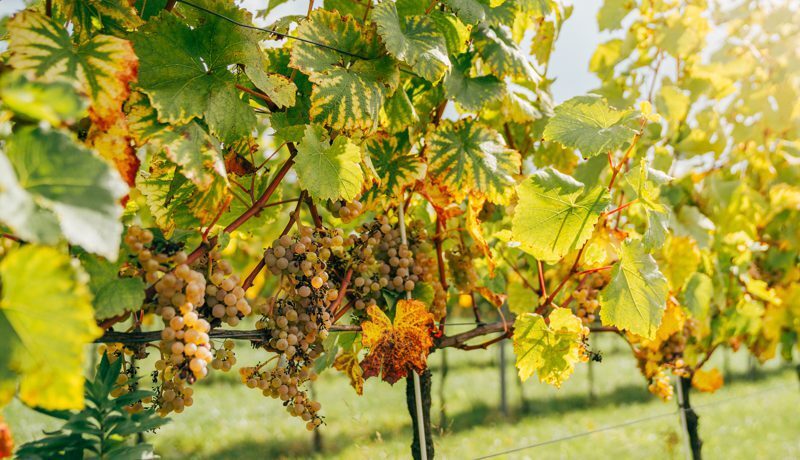
People often ask why I decided to grow an organic vineyard. What contributed to this decision? However, several myths have arisen that are definitely worth debunking.
For me, an organic vineyard was, in a sense, an obvious choice. For years, as a consumer, I’d been a proponent of healthy eating. This often meant cooking at home with local produce and avoiding fast food. In my opinion, there’s nothing better than leaving the table feeling “lighter in the stomach” and just as energized as before a meal. Healthy eating has become a permanent part of our family..
Wine was a separate issue, because for some reason I didn’t perceive wine as food. Maybe it’s different. The wine bottle only says it contains sulfites, and you wouldn’t necessarily see anything unhealthy there (apart from the alcohol itself, of course). Only later did I realize that nothing could be further from the truth, but before I did, I stumbled upon organic wines by accident, due to a hangover, which I described in detail. here.
#atfp_close_translate_span#Nevertheless, when my wife and I decided to grow grapes and make wine, the fact that it would be an organic vineyard, contrary to appearances, was not an automatic decision.
It’s important to remember that here in Poland, we’re just starting our winemaking journey. Because we’re in a so-called cold climate zone, growing is quite risky. There’s not a season without dealing with powdery mildew and gray mold. The intensity and pressure of these diseases vary depending on the season, but they always appear, and with each season, winemakers wonder how much fruit they’ll harvest this time. And it’s not just about diseases. There are also frosts and hailstorms. In our case, on a July day last season, hail destroyed 20% of our crop in 10 minutes.
The fact that you’re not sure how much you’ll harvest, the fact that for the first two or three years you have to tend to a vineyard without producing any fruit, and the fact that just starting and then maintaining it requires a small fortune makes planting a vineyard in Poland seem, for the casual observer, bordering on madness. And now, if we add to this the fact that it’s supposed to be an organic vineyard, it’s completely mind-boggling. Especially since in 2014—before planting our vineyard—I asked leading winemakers in this country what they thought about ecology, I was told that it wasn’t the case here, that many had tried and failed..
But against all odds, we decided to take the risk, even though I knew in the back of my mind that it might not work out and I’d have to switch to conventional farming. Fortunately, after four years, I can say that organic farming is not only possible, but entirely feasible..
Nevertheless, many myths have arisen because of this and need to be debunked.
Myth #1: Organic farming is about doing nothing.
“We tried organic farming, but nothing came of it,” I once heard a winemaker say. When I asked what treatments they were using, the man was surprised – “well… we didn’t do anything, pure organic farming.” Similarly, when I tell people we spray on the vineyard, I always see a look of astonishment on their faces: “You spray? It’s an organic vineyard!”
In reality, in an organic vineyard, work piles on work. Chemicals, of course, destroy nature, but it must be admitted that they are effective. We, organic winemakers, don’t possess this weapon, and our only weapon is prevention. This means we must perform various treatments throughout the season to limit disease pressure. Specifically, this means bud reduction, leaf reduction, fruit reduction, leaf topping, mechanical or manual weeding, and finally, spraying. Yes, we spray, and we do so two or even three times more than a conventional winemaker. Why? Because our pesticides, being natural, are less effective than synthetic chemicals. We simply have to spray more often..
Myth #2: Organic farming costs the same as conventional farming.
Perhaps in California or Chile, but not in Poland. Let me give you an example of weed control. A conventional winemaker will often use Roundup or another chemical to spray weeds growing in rows once, or at most twice, during the season. The cost, of course, is the chemical, the equipment, and a maximum of two days of labor. To combat weeds, we use a special mechanical weeder attached to our tractor, whose blade cuts the weed roots. Very slowly, to avoid damaging the vines, we have to drive up and down each row. In total, it takes four days to drive through the entire vineyard, and during the season, we have to weed at least four times. That’s two days for a conventional winemaker versus 16 days for an organic winemaker. You can calculate the costs yourself.
Myth #3: Polish organic wines are more expensive than conventional ones.
This is true in a typical Western country, but not in Poland. This is because today’s Polish consumer doesn’t distinguish (read: doesn’t see the positive value) organic wine from conventional wine. For the typical Joe, wine is wine. Yes, the organic revolution has already begun in our country – like mushrooms after rain, sections of vegetables, fruits, and other organic products are springing up in stores and supermarkets, and despite the higher prices, people buy them. Unfortunately, this revolution hasn’t yet reached wine..
First of all, Polish wines, whether organic or conventional, are immediately more expensive than imported ones. This isn’t due to winemaker greed, but rather the sheer cost of establishing and running a vineyard in Poland. We don’t inherit our vineyards from our fathers or grandfathers. Furthermore, we lack economies of scale; our vineyards, even the largest ones in the context of wine-producing countries, are small..
Secondly, Poles are just learning about wine and certainly don’t want to spend a fortune on something they don’t fully understand (who would?). In Poland, 90% of wines are sold for under 30 złoty. Wines produced in Polish vineyards start at 40 złoty. See this chasm? This means we, organic winemakers, can’t raise prices even further, because, as Polish winemakers, we’re already locked into higher prices, and this is a significant barrier for consumers.
Thirdly, because Poles are just learning about wine, they don’t realize that supermarket wine isn’t wine. Did you know that wine is one of the last food products whose labels don’t require labeling of its contents, except for sulfites? This is no coincidence, and fortunately, this is set to change in 2022, according to a new EU directive. People don’t realize how many flavor and color enhancers, enzymes, specially engineered yeasts, and other laboratory-made substances are present in supermarket wine..
I usually explain to people that wine is a living thing. Wine is constantly changing; it’s a constant chemical process. That’s why, for example, the same Cabernet will taste different in a year than it does today, and two years from now it will taste even different than it does a year ago..
Wine, as a living creature, dislikes light and high temperatures. Therefore, a dark bottle, a dark environment, and a low temperature are best for wine. Now, imagine wine in a clear bottle next to a sunny storefront at temperatures above 20°C. And that wine sits there for two years without spoiling. The question arises: how much wine is in the wine?
Myth #4: Why make organic wine, it’s alcohol anyway?
Alcohol kills, that’s true. It’s the cause of many diseases, also true. So, do organic wines make a difference? They do. Wine, like many food products, can affect our health positively or negatively, depending on the amount consumed. Now imagine that with relatively low consumption, you could still get cancer. Why? Because wine contains chemicals. A lot of them. According to recent studies in the United States, an average of 50 ppb (parts per billion) of glyphosate (the active ingredient in Roundup) was found in conventional wines. These are, of course, trace amounts and don’t pose a health risk in themselves, but we’re talking about a cumulative effect. The problem is that 5 ppb of glyphosate was also found in organic wines. Yes, that’s not a mistake. This is one of the tragedies of our times. Glyphosate is so ubiquitous that it’s transferred to organic crops through wind, rain, or as residue from conventional farming. If glyphosate is in wine, it’s certainly in other organic products as well. This is a warning so that we don’t wake up one day and realize that we have so poisoned the earth that healthy, uncontaminated food no longer exists!
In a perverse way, this could be a major plus for our domestic organic wines. Poland isn’t yet as contaminated as Western countries. Roundup isn’t cheap, and large-scale crops where Roundup is used almost routinely are rare. This means our organic wines are healthy. Perhaps this is our chance to export?